The Thesis: Innovation Without Trust is Just R&D
The food science sector is currently locked in a race for proprietary speed—who can scale first, who can reach price parity first. But this competitive sprint ignores a fundamental market reality: Consumers do not eat technology; they eat culture.
If the alternative protein sector fails to normalize the process of production, individual product wins will be irrelevant. We face a "category risk," not just brand risk. To bridge the gap between scientific breakthrough and the dinner table, the industry must shift from competitive fragmentation to collaborative normalization.
1. The Pre-Competitive Imperative
In mature industries, safety and standard processes are non-negotiable baselines, not competitive moats. The auto industry collaborates on safety standards; the tech industry collaborates on protocols (USB, Bluetooth).
Food tech must adopt a Pre-Competitive Collaboration Framework.
The Logic: If one company faces a safety recall or a "Frankenfood" PR crisis, the entire sector suffers (the "spinach recall" effect).
The Strategy: We must pool resources to establish rigorous, open-source safety standards that exceed regulatory minimums. By making safety a shared asset, we de-risk the category for everyone.
The Pre-Competitive Timeline: Establishing Shared Industry Standards
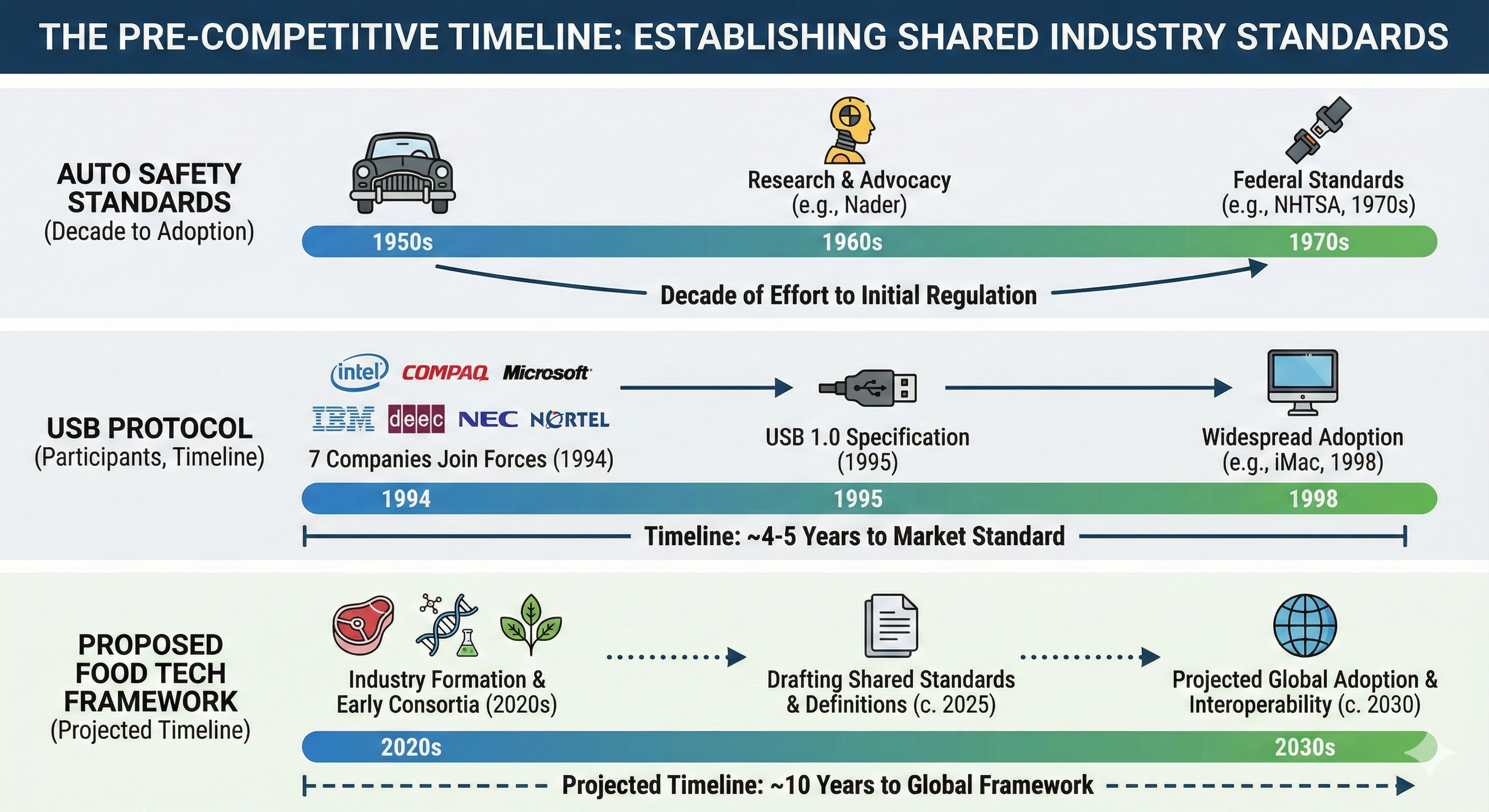
Historical precedents show how industries establish shared standards: Auto safety took a decade, USB protocol took 4-5 years with 7 companies collaborating. The proposed food tech framework projects a 10-year timeline to global adoption.
2. "Process as Brand": The Intel Inside Strategy
How do you make an invisible, complex technology valuable to a consumer? You brand the process.
Historical Precedent: Consumers didn't understand microprocessors, but they trusted "Intel Inside." They didn't understand waterproof membranes, but they trusted "Gore-Tex."
The Opportunity: We need a unified "Ingredient Brand" for the process of cellular agriculture and high-fidelity fermentation. This seal shouldn't just mean "safe"; it should signify "The Gold Standard of Craft."
The Shift: When a consumer sees this seal, they shouldn't think of a laboratory. They should think of a brewery.
The Process Brand Precedent Matrix
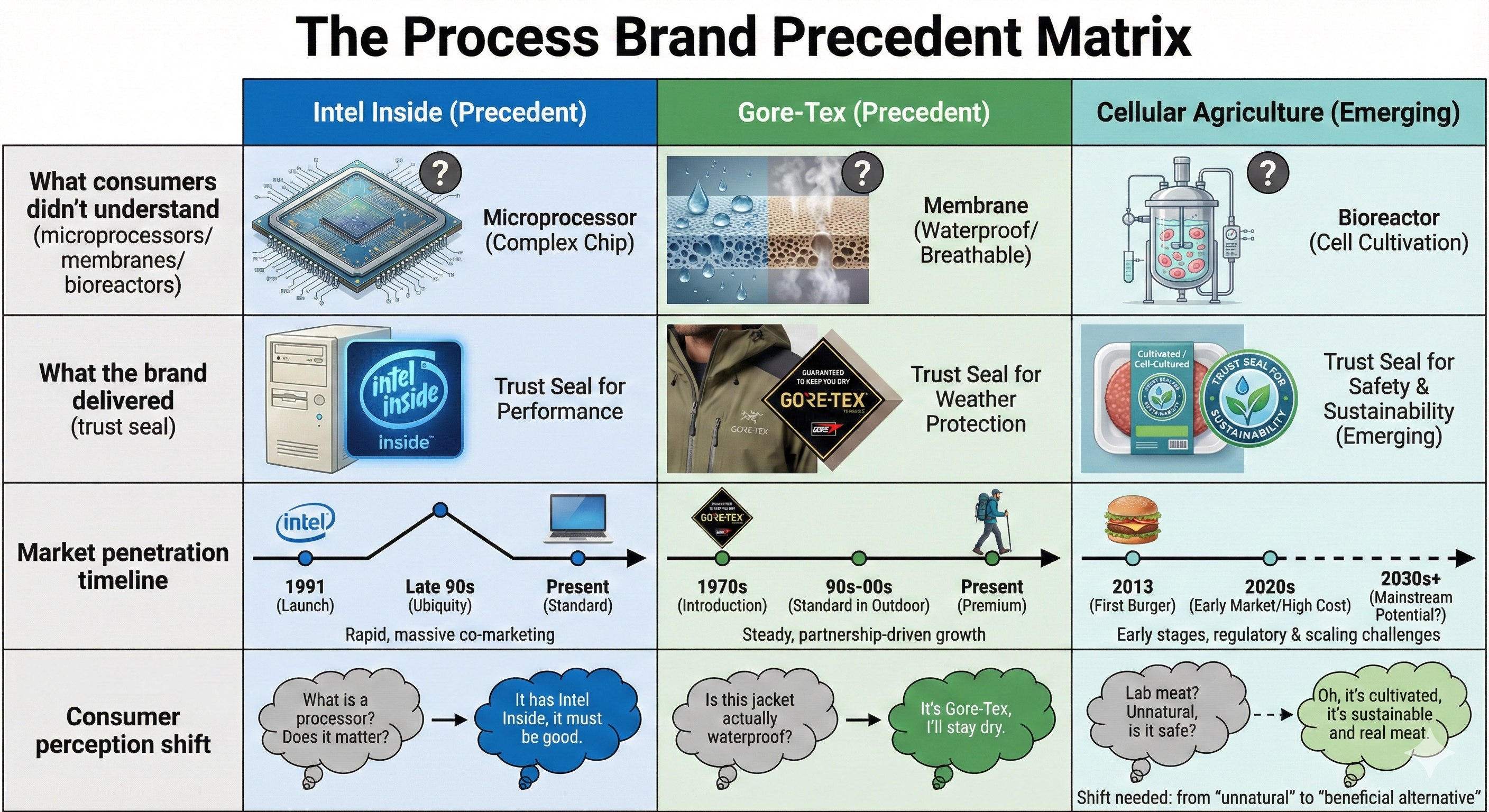
Comparing how Intel Inside and Gore-Tex successfully branded complex technologies, and how cellular agriculture can follow the same path.
3. Marketing the "Glass Box": Radical Transparency
The current industry instinct is to hide the science—to make the packaging look pastoral and hope consumers don't ask questions. This is a losing strategy. In the age of information, opacity breeds suspicion.
We propose a "Glass Box" Marketing Strategy:
Reclaiming the Narrative: We must stop apologizing for the science and start celebrating the craft. Bioreactors are not "vats"; they are the modern equivalent of cheese caves or fermentation tanks.
The Unified Story: Instead of 50 companies fighting to explain their specific tech, we need one overarching campaign that explains the category.
From: "Lab-Grown Meat" (Alien, Sterile)
To: "Cultured & Crafted" (Warm, Human, Intentional)
Vocabulary Progression: From Lab to Table
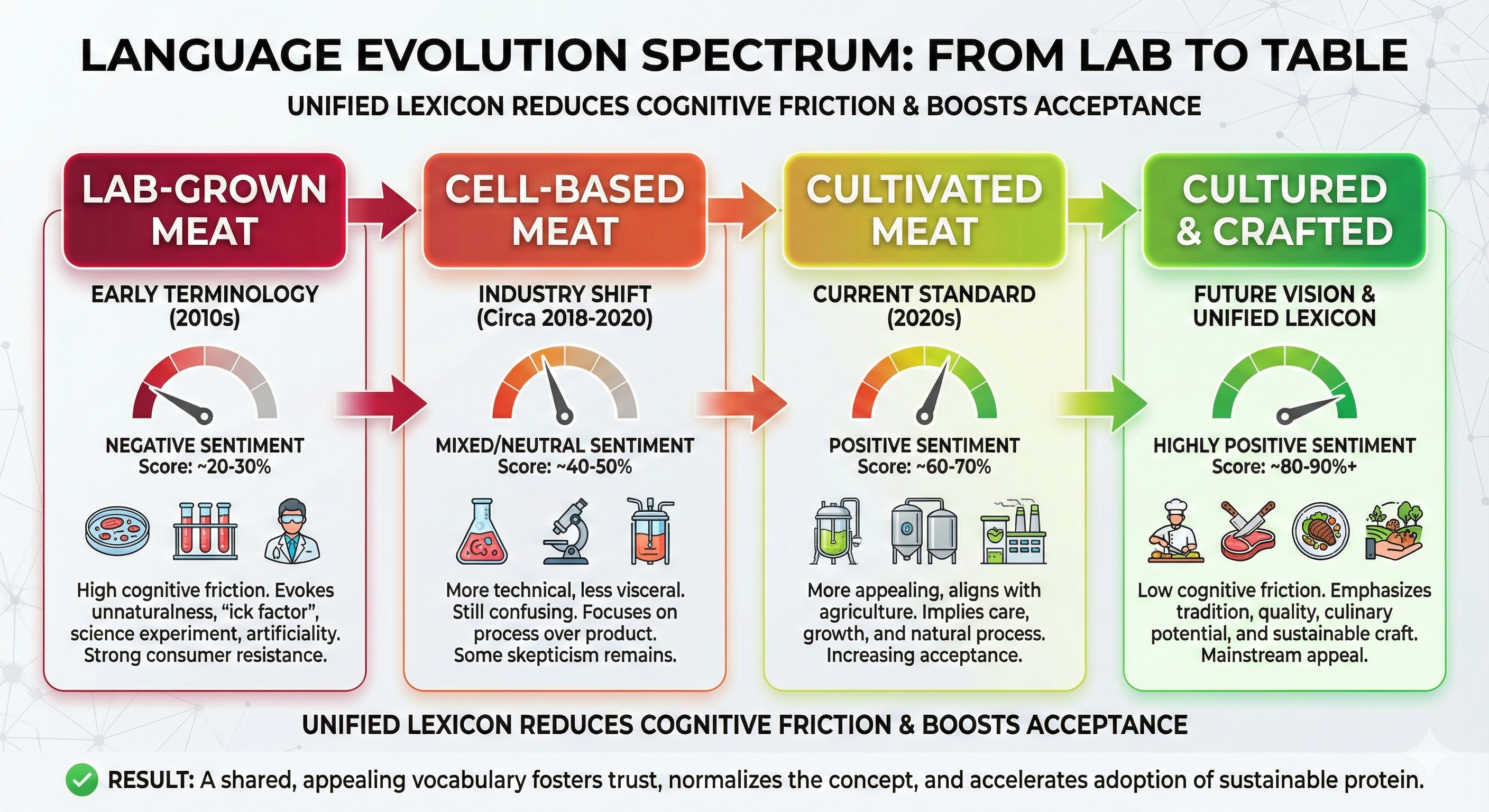
The evolution of terminology from "Lab-Grown Meat" to "Cultured & Crafted" demonstrates how unified lexicon reduces cognitive friction and boosts acceptance, moving consumer sentiment from negative to highly positive.
4. The "Future Food Trust" Framework
To execute this, we propose the formation of a cross-industry coalition focused on three pillars of influence:
Pillar A: The standard is the Product
We need a third-party, audit-verified seal (The "PureProcess" Standard) that guarantees:
- Safety Beyond Compliance: Testing for novel contaminants that regulators may miss.
- Nutritional Integrity: Ensuring the end product isn't just a protein match, but a nutritional upgrade.
Pillar B: Shared Lexicon
We must agree on the words we use. A fractured vocabulary (cell-based vs. lab-grown vs. cultivated) confuses consumers. A unified industry voice, backed by consumer linguistic research, settles the debate and lowers the cognitive load for shoppers.
Pillar C: The "Kitchens of the Future" Campaign
A joint marketing fund dedicated not to selling specific burgers or nuggets, but to selling the method.
Tactics: "Open Kitchen" pop-ups, influencer chef councils, and educational content that demystifies the production process.
Goal: To make the bioreactor as mundane and accepted as the beer fermenter.
Conclusion: Rising Tides
The companies that win the next decade will not just be the ones with the best IP; they will be the ones that effectively partner to build a new cultural norm. By establishing a shared "Process Brand" founded on rigorous transparency, we don't just protect our individual bottom lines—we unlock the true potential of the entire food revolution.